
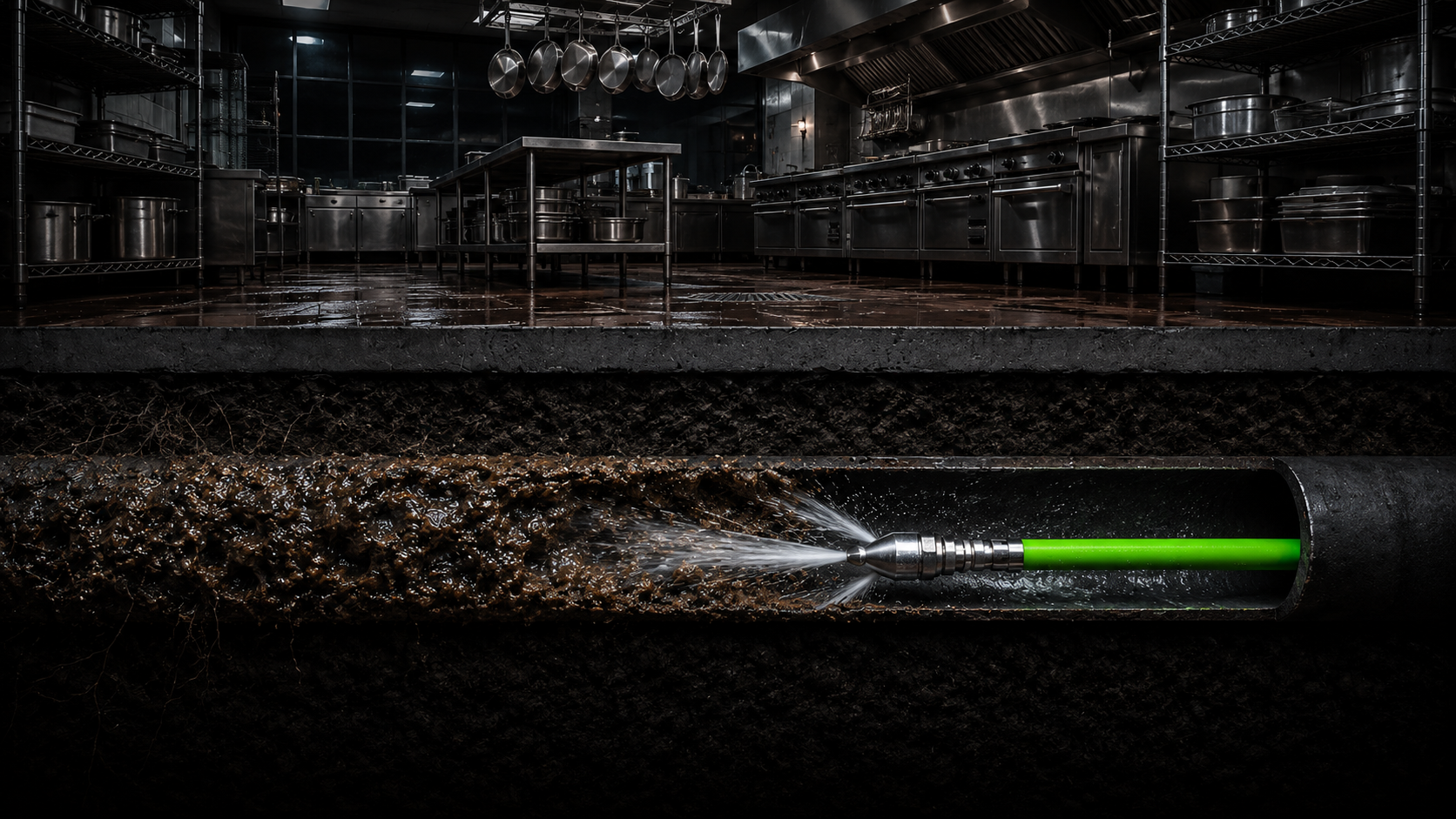
Grease buildup in a kitchen sanitary line does not announce itself until a fryer line backs up during Friday dinner service. Hydro jetting clears the fat, oil, and grease coating that a mechanical snake just pushes further down the pipe, and this guide covers what to check before you hire a provider to run pipeline cleaning through your lines.
High pressure water jetting scours the full pipe wall instead of punching a channel through a clog. For grease heavy kitchen lines, that difference determines whether the line stays clear for months or backs up again in six weeks. A CCTV verified pipeline cleaning program from a NASSCO certified provider is the right move for any restaurant with recurring backups. A single reactive jet with no inspection only treats the symptom.
Why This Matters
A restaurant kitchen line is not a residential drain. Fryer oil, dish pit fat, and food solids congeal against warm pipe walls at a rate no other commercial tenant produces, and a single missed cleaning cycle can turn a 6 inch line into a 2 inch bottleneck within a quarter. Florida health departments tie repeat sewer backups to inspection findings, and a documented cleaning and CCTV history is often the difference between a warning and a citation.
Grease that is not cleared inside the property line moves downstream into the municipal collection system, and that is exactly the kind of blockage that contributes to a sanitary sewer overflow (SSO) event tracked by the Florida Department of Environmental Protection. Facility managers who treat pipeline cleaning as a scheduled service, not an emergency call, avoid both the fine and the downstream liability.
Who This Is For
This guide is built for restaurant owners, multi unit facility managers, and property managers responsible for kitchen line maintenance across food service tenants. If you have had more than one backup in the last 12 months, or a health authority has flagged your line maintenance plan, the criteria below apply directly to you.
What to Look for in Pipeline Cleaning for Restaurant Kitchens
CCTV Inspection Before & After the Jet
A provider that jets blind is guessing at pipe condition. Video inspection before the work identifies soft grease buildup versus hardened scale bonded to the pipe wall, and post jet footage proves the line was actually cleared.
PSI & Nozzle Selection Matched to Severity
Grease lines typically run 3,000 to 4,000 PSI with a rotating or penetrating nozzle. A contractor running one PSI setting for every job is not matching the tool to the problem, and that shows up as recurring service calls.
Documented Service Reporting
Most county health departments want a paper trail covering date of service, footage of line condition, and volume of debris removed. A provider that hands you a photo only invoice with no line condition data leaves you unprotected at your next inspection.
Response Time for Emergency Backups
A line backup during service hours is a revenue event, not just a maintenance one. Ask what same day or next day availability looks like before you sign a maintenance agreement.
Licensing Specific to Commercial Sanitary Sewer Work
Confirm the crew running the jet truck is licensed for commercial sanitary sewer work under Florida statutes, not just general plumbing.
A Scheduled Cadence, Not One Off Jetting
A single jetting event resets the clock, but grease reaccumulates on a predictable schedule tied to kitchen volume. A provider who proposes a quarterly or semiannual cadence based on your buildup rate is planning for prevention.
Top Approaches That Actually Work
CCTV inspected pipeline cleaning with service documentation. A line inspected before jetting shows the actual grease layer thickness in inches, which tells you whether 3,000 PSI clears it in one pass. This is the approach that gives you both a clean line and a compliance record.
Scheduled quarterly jetting tied to kitchen volume. High volume kitchens see grease reaccumulate faster than low volume operations, so a fixed quarterly cadence beats waiting for the next call.
Reactive emergency jet with no inspection. This clears the immediate blockage with no video record and no read on whether hardened scale remains bonded to the pipe wall. Treat this as a stopgap, never as the only line of defense.
Combined jetting and root cutting for older cast iron lines. Restaurants in buildings with pre 1980s cast iron sanitary lines sometimes deal with root intrusion layered under grease buildup, which needs a higher PSI pass and a different nozzle.
Mechanical snaking instead of jetting. A snake punches a hole through the clog and leaves the grease coating intact on the pipe wall, which means the same spot reclogs within weeks. Skip this for any line with established buildup.
What to Avoid
Quotes with no PSI or nozzle spec listed leave you no way to verify the job matched the pipe condition. Providers who will not show pre or post jet video are skipping the documentation that justifies hiring a licensed crew. One time cleanings sold as a permanent fix ignore that grease reaccumulates on a schedule tied to your kitchen's output.
Verdict Comparison
| Approach | PSI Range | Inspection Included | Documentation | Best For |
|---|---|---|---|---|
| CCTV Inspected Jetting | 3,000 to 4,000 | Yes | Yes | Recurring Backups |
| Scheduled Quarterly Service | 3,000 to 4,000 | Yes | Yes | High Volume Kitchens |
| Reactive Emergency Jet | Varies | No | No | Stopgap Only |
| Jetting Plus Root Cutting | 4,000 Plus | Yes | Yes | Pre 1980 Buildings |
| Mechanical Snaking | N/A | No | No | Not Recommended |


