
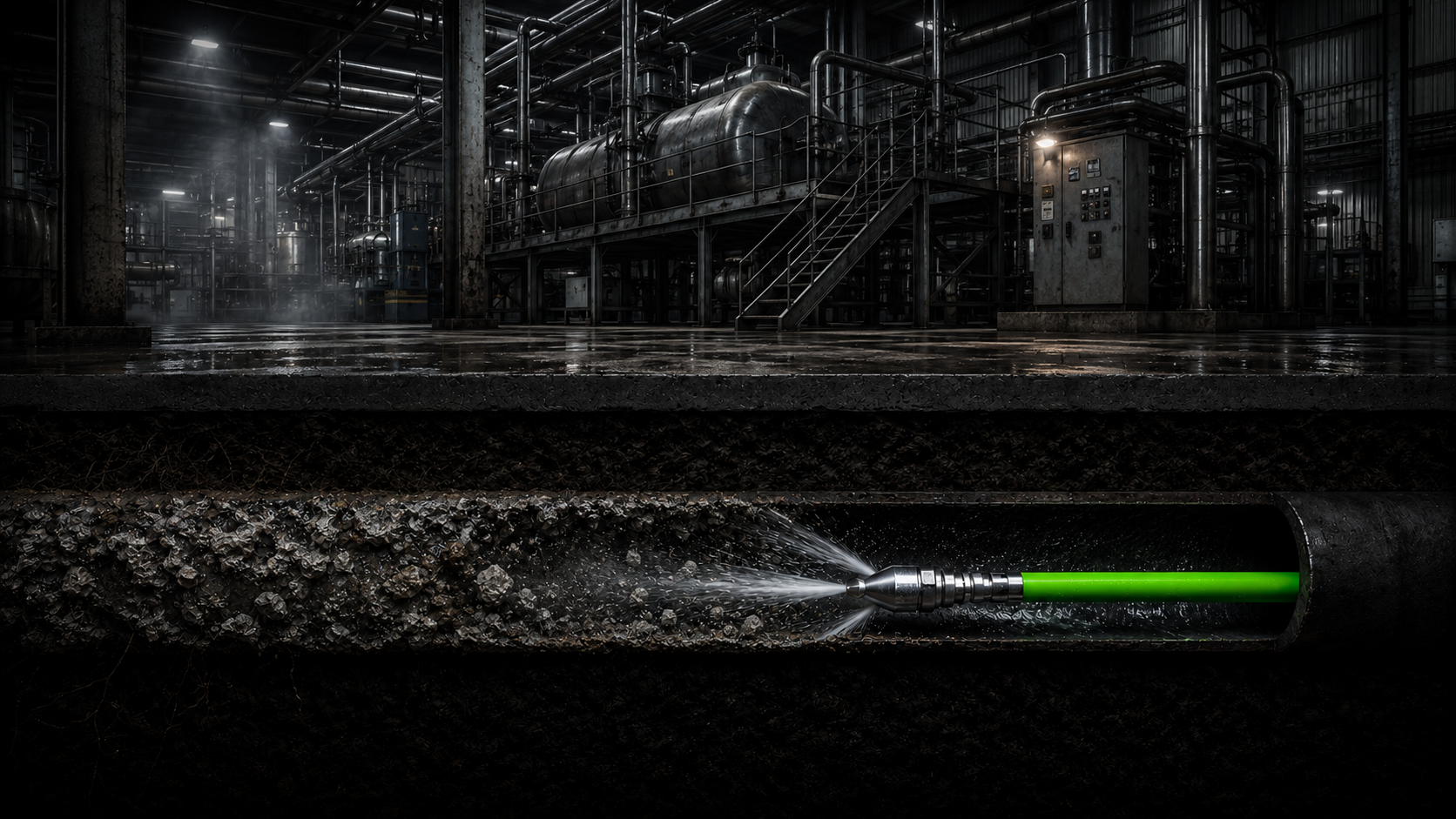
Hydro jetting for manufacturing plants clears scale, sediment, and root intrusion from sanitary lines that carry industrial process discharge, work that general plumbing crews are not equipped to document or certify.
Why This Matters
A manufacturing plant's sanitary sewer line is not a homeowner's drain. It carries process discharge, higher solids loads, and often decades of scale buildup on cast iron or clay pipe installed before 1980. Southeast Services has logged 10M+ feet of pipe experience across Florida since 2005, and the pattern repeats at almost every industrial site: nobody jets a line until it backs up, and by then the scale is thick enough to block a liner from bonding.
Florida's Department of Environmental Protection tracks sanitary sewer overflow (SSO) incidents statewide, and blocked or partially blocked lines remain one of the most common causes on record. A plant with an industrial pretreatment permit under the EPA's national framework (40 CFR 403) carries a direct compliance interest in keeping its collection lines clear. In 2026, that means jetting is not maintenance you defer, it is documentation you need on file.
Who This Is For
This guide is written for plant engineers, EHS managers, and facility managers at manufacturing sites in Florida with sanitary sewer lines carrying industrial process discharge. If your plant runs continuous shifts, has cast iron or clay lines installed before 1980, or needs pretreatment compliance records for a permit renewal, this is your buying guide. It is not written for grease trap service, general plumbing repair, or septic systems, none of which fall under hydro jetting for sanitary sewer infrastructure.
What to Look for in Hydro Jetting for Manufacturing Plants
PSI & GPM Matched to Pipe Material
Cast iron, clay, and PVC scale differently, and a crew running the wrong pressure either fails to clear buildup or erodes pipe wall on older cast iron. Manufacturing lines typically need 3,000 to 4,000 PSI with flow rates tuned to pipe diameter, from 4-inch laterals up to 24-inch trunk lines. A contractor who runs one PSI setting for every job is guessing.
NASSCO Certified Documentation Before & After
Every cleaning job on an industrial line should produce a NASSCO certified CCTV record, before and after footage that documents pipe condition to the foot. This record becomes your evidence file for capital planning, insurance, and any pretreatment audit. Without it, you have a clean pipe and no proof it was ever a problem.
Root Cutting & Mechanical Descaling Capability
Water alone does not remove calcified scale or root intrusion on older cast iron and clay lines. A crew needs mechanical cleaning and root cutting equipment on the truck, not just a jetting hose. If descaling is not part of the scope, scale stays on the pipe wall and any future liner has nothing to bond to.
Scheduling Around Production Shutdowns
Manufacturing plants run shifts, and unplanned line access shuts down production. Cleaning should schedule around your shift calendar and planned maintenance windows, not around the contractor's availability. A crew that cannot commit to a specific window is a scheduling risk to your production line.
Statewide Licensing & Industrial Experience
Florida requires specific licensing for sanitary sewer and stormwater contractors, and industrial sites carry more liability than a residential job. A statewide, fully licensed contractor with documented industrial experience is a different risk profile than a local plumber picking up a jetting job on the side.
The Right Hydro Jetting Approach for Your Plant
Scheduled Preventive Jetting: The Safe Pick
Annual or semiannual jetting cycles at 3,000 to 4,000 PSI keep cast iron and clay lines clear before scale becomes a blockage risk. This is the baseline program for any plant with a pretreatment permit or a rehabilitation budget on the books. Verdict: Buy.
Pre-Rehabilitation Jetting & CCTV: The Smart Pairing
Before cured-in-place pipe (CIPP) lining or a sectional point repair, the line has to be clean enough for a liner to bond to bare pipe wall. Jetting paired with NASSCO certified CCTV inspection documents condition and clears the way in one mobilization, the same approach used on commercial pipeline cleaning work in Sebastian, FL. Verdict: Buy.
Heavy Descaling for Calcified Industrial Lines: The Specialist Job
Lines with decades of mineral or process buildup on cast iron need mechanical descaling before a standard jetting pass will hold. This is a specific scope, not a default add-on, and it should be priced and scheduled separately once a CCTV inspection confirms scale depth. Verdict: Consider.
Reactive Emergency-Only Jetting: The Wildcard
A one-time jetting call after a backup clears the immediate problem but leaves no CCTV baseline and no documentation for your files. Fine as an emergency response. Not a program. Verdict: Skip as a standalone maintenance plan.
General Plumber-Grade Jetting: Looks Right, Isn't
Lower PSI, no root cutting attachment, no NASSCO certification, and no CCTV camera on the truck. It clears an immediate clog and produces nothing you can hand to an auditor or a capital planning committee. Verdict: Skip.
What to Avoid
- A crew that skips descaling on calcified lines. Jetting alone will not remove decades of mineral buildup, and a liner applied over scale fails early.
- A contractor who can't produce CCTV documentation. If there's no before-and-after footage, you have no proof of condition and no defensible record for a pretreatment file.
- Scheduling that ignores your shift calendar. A jetting crew that shows up without coordinating with your production supervisor turns routine maintenance into unplanned downtime.
Verdict Comparison
| Approach | PSI Range | Documentation | Best For | Verdict |
|---|---|---|---|---|
| Scheduled Preventive Jetting | 3,000 to 4,000 PSI | NASSCO CCTV Each Cycle | Ongoing Compliance Programs | Buy |
| Pre-Rehab Jetting &Amp; CCTV | 3,000 to 4,000 PSI | Full Condition Record | Before CIPP or Point Repair | Buy |
| Heavy Descaling | Up to 4,000 PSI Plus Mechanical | Scale Depth Documented | Older Cast Iron &Amp; Clay Lines | Consider |
| Reactive Emergency-Only | Varies by Call | None | One-time Backups Only | Skip as a Program |
| General Plumber-Grade | Below 3,000 PSI | None | Nothing on an Industrial Line | Skip |
Frequently Asked Questions
What PSI is used for hydro jetting in manufacturing plants? Industrial sanitary lines are typically jetted at 3,000 to 4,000 PSI, tuned to pipe material and diameter. Cast iron and clay tolerate different pressures than PVC, and a contractor should adjust per line rather than run one setting across the site.
Is hydro jetting safe for cast iron & clay industrial lines? Yes, when PSI and flow are matched to the pipe's age and material condition. Older cast iron installed before 1980 needs a CCTV assessment first to confirm wall thickness before high-pressure cleaning begins.
How often should a manufacturing plant schedule hydro jetting? Annual or semiannual cycles are standard for plants with continuous industrial discharge. Lines with heavy scale history or frequent backups may need quarterly cleaning until a rehabilitation plan is in place.
What's the difference between hydro jetting & CCTV inspection? Jetting cleans the pipe, CCTV inspection documents its condition. Pairing both in one mobilization gives you a clean line and a NASSCO certified record you can use for capital planning.
Does hydro jetting help before CIPP lining? Yes, cured-in-place pipe (CIPP) lining requires a clean pipe wall for the liner to bond correctly. Jetting and descaling ahead of a liner install are standard pre-rehabilitation steps, not optional extras.
How much does hydro jetting for manufacturing plants cost? Cost depends on pipe diameter, scale condition, and access, and options vary by site. A CCTV assessment first gives you an accurate scope before any pricing conversation.
Can hydro jetting be scheduled around production shutdowns? Yes, and it should be. A statewide contractor with industrial experience will build the cleaning window around your shift calendar, not the other way around.
Is hydro jetting for manufacturing plants the same as grease trap cleaning? No. Hydro jetting for sanitary sewer and process discharge lines is a distinct service from grease trap service, which Southeast Services does not provide. This guide covers sanitary sewer infrastructure only.
One Last Thing
Plants that align hydro jetting and CCTV inspection with their pretreatment permit renewal cycle avoid a second mobilization later in the year. Scheduling both in the same visit in 2026 costs less crew time than treating cleaning and documentation as two separate projects, and it puts a NASSCO certified record on file before an auditor ever asks for one.


