Sewer line repair for HOA communities is not the same job as a single-family home repair. One failed cast-iron main under a courtyard can affect a dozen units, a full common-area budget, and a board's ability to explain the bill at the next meeting. This guide breaks down what a board should demand before signing a contract, what the repair options actually are, and where the shortcuts show up.
Why This Matters
Cast-iron sanitary lines installed in Florida between the 1950s and 1970s are now 55 to 75 years old, and that housing stock is the single largest driver of sanitary sewer overflow (SSO) risk on private common-area infrastructure statewide. The Florida Department of Environmental Protection logs SSO incidents tied to collapsed laterals and root-blocked mains every year, and coastal corrosion plus high water tables accelerate the failure timeline compared to inland installations.
A board that authorizes a repair without a documented condition assessment is buying blind. ASTM F1216, the governing standard for cured-in-place pipe rehabilitation, exists precisely because scoping a line without inspection data leads to change orders mid-project, and change orders are what blow up reserve budgets.
Who This Is For
This guide is written for HOA and condominium board members, community association managers, and reserve study preparers responsible for sanitary sewer lines running under buildings, courtyards, and common areas in Florida associations, particularly those built before 1980 with cast-iron or clay drain systems. If your community is budgeting a Structural Integrity Reserve Study (SIRS) line item for plumbing infrastructure, this applies directly to you.
What To Look For In Sewer Line Repair For HOA Communities
A Condition Assessment Before A Quote
No board should approve a repair scope based on a verbal estimate. A NASSCO-certified CCTV inspection documents pipe material, defect location, and severity before anyone prices the job, which is the only way to catch a $15,000 job from becoming a $60,000 job mid-repair.
Trenchless Capability, Not Just Trenchless Marketing
Any contractor can say "no-dig." Fewer can actually perform cured-in-place pipe (CIPP) lining, sectional point repair, and small-diameter in-building rehabilitation on the same crew. Ask which methods the contractor self-performs versus subcontracts, because subcontracted trenchless work adds a coordination layer your board does not need.
Experience With Florida's Cast-Iron Housing Stock
A contractor who has lined 10M+ feet of pipe in Florida knows how cast iron from the 1950s to the 1970s fails differently than clay or PVC, and scopes accordingly. General plumbing experience does not transfer to lateral rehabilitation the way boards assume it does.
Licensing That Covers The Full Scope
Sanitary sewer rehabilitation touches plumbing, underground utility, and general contracting code categories depending on the work. A contractor holding the relevant Florida licenses, CFC1429186, CUC1223872, and CGC1525265, removes the risk of a scope gap between trades.
A Written Report The Board Can Defend
Boards answer to owners and to auditors. A standardized rehabilitation readiness report that documents pipe condition, defect severity, and scope before pricing gives the board a paper trail if an owner questions the spend, not just a verbal recommendation.
Emergency Response Capacity
Sanitary lines fail during storm season, not on a convenient Tuesday. A contractor with hydro-excavation and vacuum excavation capability on staff can respond to an active backup without waiting on a subcontractor's schedule.
The Four Repair Approaches For HOA Boards
NASSCO-certified CCTV inspection with a written condition report. The diagnostic step every project should start with. It costs a fraction of the eventual repair and tells the board exactly what they are buying before a number gets attached to it. Recommended, and non-negotiable before any repair contract.
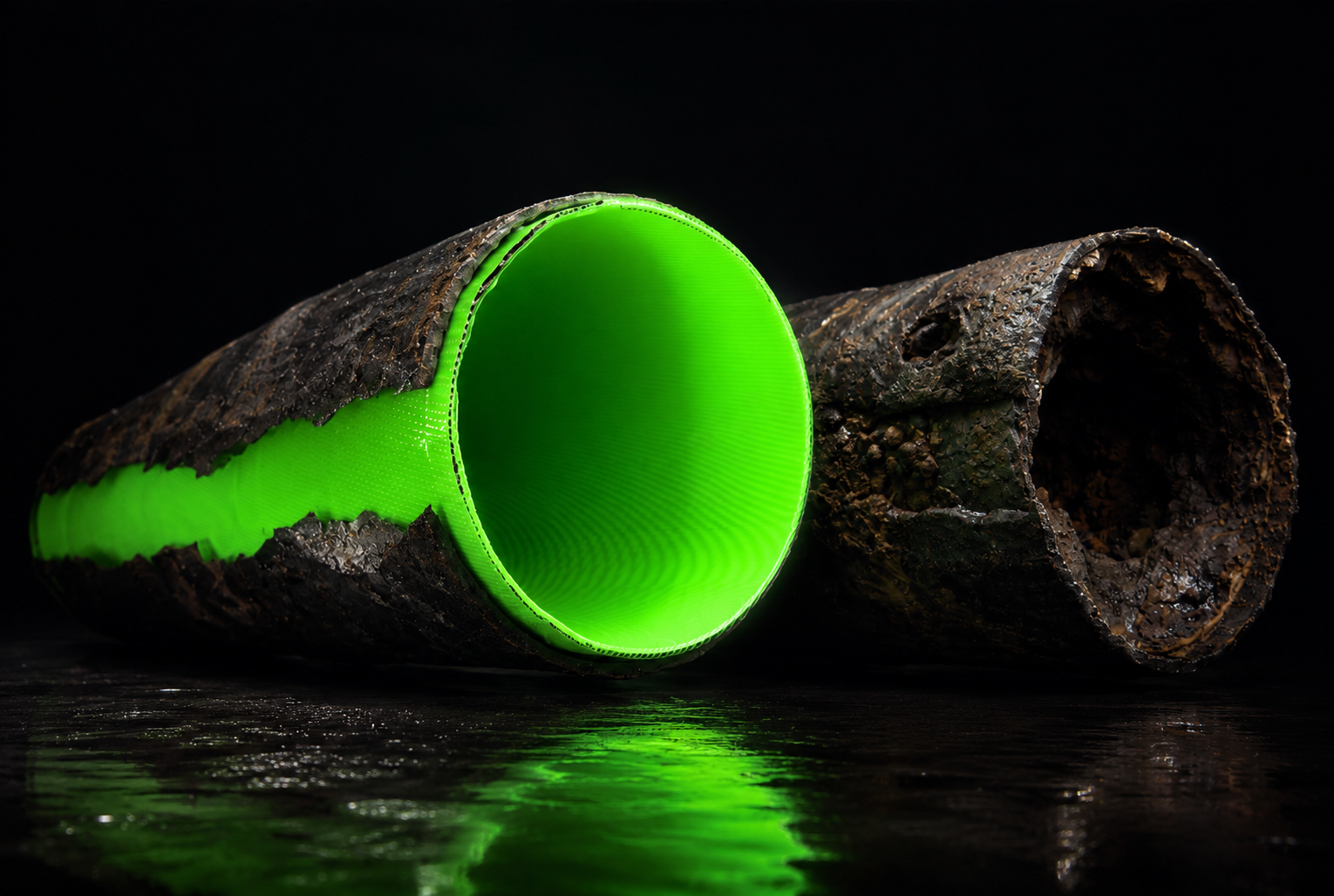
Cured-in-place pipe (CIPP) lining. The standard fix for a full pipe segment showing cracking, root intrusion, or joint failure along its length. It cures in place inside the existing pipe, so common-area landscaping, parking, and building slabs stay untouched. Structural life on a properly installed CIPP liner runs decades past a typical HOA's reserve planning horizon. Recommended for segment-length cast-iron or clay failures.
Sectional point repair. The targeted fix for an isolated defect, a single cracked joint or offset section, rather than degradation running the full pipe length. It costs less than a full liner because it only treats the failure point, but it does not address adjacent pipe that is close behind in condition. Consider it when the inspection report shows one isolated defect and the rest of the line scores clean.
Full excavation and replacement. The last-resort option when a line has collapsed, offset beyond what lining can correct, or sits in a location where trenchless access is physically impossible. It means torn-up common areas, longer timelines, and the highest disruption cost to residents. Skip this unless the condition report specifically rules out trenchless methods.
What To Avoid
- A spot patch sold as a full repair. A patch on one section without inspecting the rest of the line hides the fact that adjacent pipe is often at the same age and condition. It looks cheaper on the invoice and costs more within 24 months.
- A contractor without the required Florida licenses. Sanitary sewer rehabilitation spans plumbing, underground utility, and general contracting code categories. A single-license contractor working outside their scope creates liability exposure for the association, not just the contractor.
- A verbal quote with no written condition report. If a contractor cannot produce documented defect locations and severity ratings before pricing, the board has no way to verify the scope matches the actual pipe condition, and no paper trail if an owner challenges the expense later.
Verdict Comparison
| Approach | Disruption to Common Areas | Best For | Verdict |
|---|---|---|---|
| CCTV Inspection &Amp; Report | None | Every Project, Before Any Contract | Recommended, Required First Step |
| Cured-in-place Pipe (CIPP) Lining | Minimal, No Dig | Full-length Defects in Cast Iron or Clay | Recommended |
| Sectional Point Repair | Minimal, Localized Access | Single Isolated Defects on an Otherwise Sound Line | Consider |
| Full Excavation &Amp; Replacement | High, Common Areas Torn Up | Collapsed Lines or Physically Inaccessible Sites | Skip Unless Trenchless Is Ruled Out |